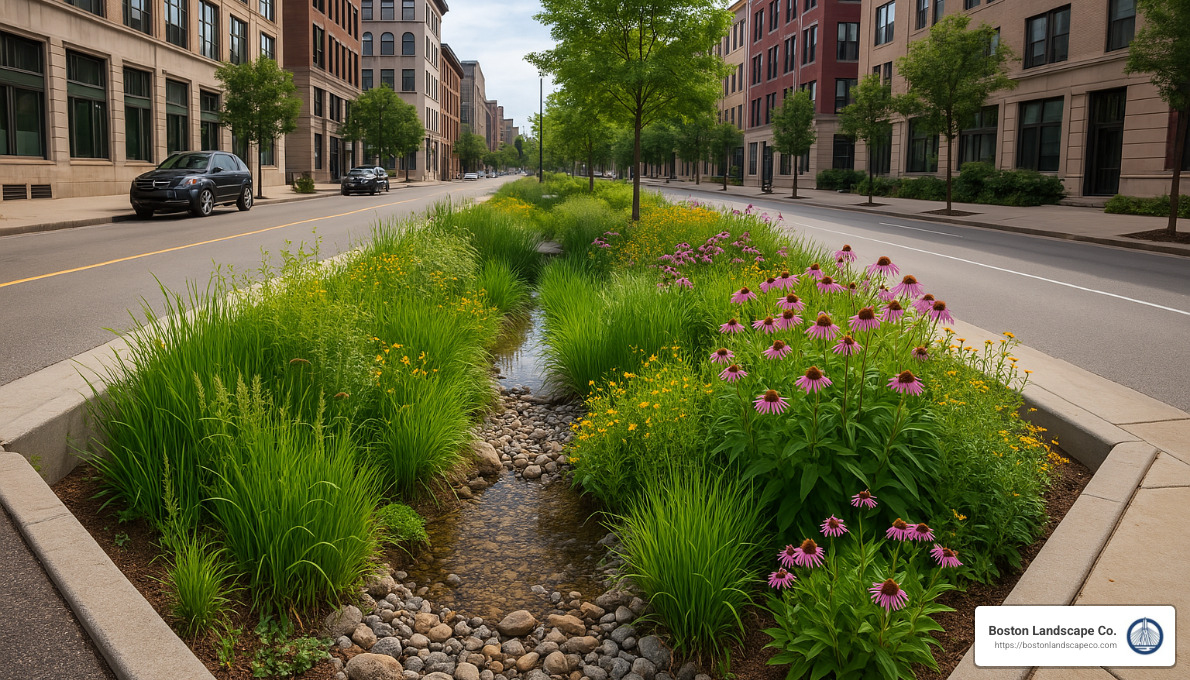
[Photo by Boston Landscape Co.]
When city planners think about climate infrastructure, they typically envision solar panels, electric vehicle charging stations, and energy efficient buildings. Rarely do they consider the grass, trees, and planted areas surrounding those buildings as critical climate infrastructure. But the data tells a different story: urban landscapes may be our last and best opportunity to address three of the most pressing environmental challenges cities face.
The Triple Threat: What Urban Landscapes Must Address
Urbanization creates a perfect storm of environmental challenges. When we replace permeable meadows, forests, and grasslands with concrete, asphalt, and buildings, we fundamentally alter three critical ecological processes:
1. Stormwater Runoff Amplification
Natural landscapes absorb rainfall. Urban landscapes shed it.
A single acre of meadow can absorb and filter thousands of gallons of water during a rainstorm. The same acre covered in impervious surfaces such as parking lots, roads, buildings converts that absorption capacity into runoff. Instead of water soaking into the ground, it races across pavement, picking up pollutants and overwhelming stormwater systems.
The numbers are stark:
- Natural grassland: 95-100% rainfall infiltration
- Well maintained urban landscape: 50-70% infiltration
- Conventional urban hardscape: 5-15% infiltration
That runoff isn't just water, it's a toxic cocktail. Every drop flowing across an impervious surface collects motor oil, heavy metals from brake dust, fertilizers, pesticides, and countless other pollutants. Traditional stormwater management, which focuses on a linear process of pipes and detention basins and sometimes wastewater treatment facilities, just moves this problem downstream. It doesn't solve it.
Pollutant Breakdown Failure
Here's what most people don't realize: soil isn't just dirt. Healthy soil is one of nature's most sophisticated pollution control systems.
Healthy soil contains billions of microorganisms per teaspoon. These microscopic workers break down organic pollutants, filter heavy metals, neutralize pathogens, and transform toxic compounds into harmless elements. But this biological filtration doesn't happen on concrete. It doesn't happen on asphalt. It only happens in living soil with active plant growth.
Urban and industrial activities generate concentrated pollutant loads that would overwhelm even natural ecosystems. Vehicle emissions, industrial processes, construction activities, and normal urban life create chemical compounds that need biological breakdown. When we eliminate the soil systems that perform this function, those pollutants have nowhere to go except into our water supplies or air.
Research from the University of Melbourne shows that urban areas, despite their reputation as "biological deserts”, actually harbor important biodiversity when properly managed green spaces are included. These spaces provide critical ecosystem services including pollutant breakdown that can't occur on impervious surfaces.
Killing Carbon Sequestration
Photosynthesis is the original carbon capture technology. Plants pull CO2 from the atmosphere and, through their relationship with soil microbes, store it in stable organic compounds. This process has regulated atmospheric carbon for millions of years.
Impervious surfaces stop this process completely. No plants = no photosynthesis = no carbon capture. Worse, the energy used to produce and maintain these surfaces actually releases carbon.
The Ecological Landscape Alliance reports that properly managed landscapes can sequester significant amounts of carbon. Starting with baseline soil carbon of 1-2%, regenerative management can increase this to 5-8% over ten years. While 1% of carbon in soil equals about 8.5 tons per acre, after ten years there can be 25-60 tons of carbon per acre.
For context, the United States has over 40 million acres of lawn alone, not counting other landscaped areas. If even half of this area adopted regenerative practices, the carbon sequestration potential is massive.
The Urban Landscape Paradox
This brings us to a fascinating paradox: urban landscapes are simultaneously our biggest environmental problem and our most promising solution.
The problem is clear: urbanization destroys natural ecological function. But here's the opportunity: the landscaped areas that remain in urban settings are literally the last remaining space where we can restore these critical processes.
- Roads and parking lots: 29% of urban area
- Buildings: 25% of urban area
- Sidewalks and hardscape: 11% of urban area
- Landscaped areas (parks, yards, medians, commercial landscapes): 35% of urban area
That 35% is it. It's the only space left where soil biology can function, where plants can photosynthesize, where water can infiltrate. And unlike rural or wild lands, these urban landscapes are in immediate proximity to the pollution sources, the impervious surfaces creating runoff, and the carbon emissions that need sequestration.
The 200-400% Performance Standard
If urban landscapes are our last line of defense, they can't just match natural ecosystem performance, they need to be designed to dramatically exceed.
ReScape California has established a provocative but achievable standard: properly designed and maintained urban landscapes should perform at 200-400% of natural, undisturbed lands in three critical metrics:
Water Infiltration and Storage
Natural meadow: ~1 inch of water per hour infiltration.
Regenerative urban landscape target: 2-4 inches per hour
How is this possible? Engineered soil systems can be designed with higher organic matter content, better aggregate structure, and deeper profiles than many natural soils. Combined with strategic planting and maintenance, these landscapes become super-absorbers of stormwater.
Pollutant Breakdown
Natural forest: Baseline pollutant processing capacity
Regenerative urban landscape target: 2-4x natural capacity
Urban landscapes can be designed with plant species specifically selected for pollutant uptake, soil amendments that enhance microbial diversity, and layered systems that maximize contact time between water and biological filters. The result: better pollution control than natural areas that never evolved to handle urban pollutant loads.
Carbon Sequestration
Natural grassland: ~1,000 pounds of carbon per acre per year
Regenerative urban landscape target: 2,000-4,000 pounds per acre per year
How? More intensive management of soil organic matter, higher plant density, species selection for biomass production, deep root systems and longevity, and practices that maximize both above-ground and below-ground carbon storage.
Case Study: Seattle's Roadside Revolution
When Seattle's Department of Utilities replaced an open ditch stormwater drain with a roadside swale garden, they achieved something remarkable: a 97% reduction in runoff.
Think about that. A simple landscape intervention captured 97 out of every 100 gallons of runoff that previously overwhelmed the stormwater system. The swale garden used native plants selected for their deep roots, engineered soil designed for rapid infiltration, and strategic grading to slow water flow.
The result wasn't just stormwater management. The same planting:
- Filters pollutants before they reach waterways
- Sequesters carbon in plant biomass and soil
- Provides urban wildlife habitat
- Reduces urban heat island effect through evapotranspiration
- Improves neighborhood aesthetics and property values
This is the power of approaching urban landscapes as climate infrastructure rather than mere decoration. It protects everything from our neighborhoods to fisheries downstream we rely on. In Seattle, groups like Salmon Safe offer unique certification programs to help guide this process.
The Three Essential Functions
For urban landscapes to serve as effective climate infrastructure, they must perform three essential, interconnected functions:
Function 1: Stormwater Volume Reduction
Traditional stormwater management focuses on rate reduction, slowing water down so pipes don't overflow. Volume reduction is different: it's about reducing the total amount of water entering the system.
Regenerative landscapes achieve volume reduction through:
- Soil infiltration: Water soaking into improved soils never enters the storm system
- Plant uptake: Deep-rooted plants extract and transpire thousands of gallons
- Evaporation: Extended water contact time allows atmospheric return
- Aquifer recharge: Infiltrated water replenishes groundwater rather than causing flooding
The Capitol Region Watershed District in St. Paul, Minnesota, designed a "rain train" system of retention basins at descending elevations. These rain gardens infiltrate up to 5.3 inches of rain within 24 hours which represents a rarer, 50-year storm event. The key? Native plants with deep roots (some extending 10+ feet), engineered soil with 18 inches of amended material, and strategic design that maximizes water contact with biological filtration.
Function 2: Pollutant Breakdown and Removal
Urban runoff carries a nightmare cocktail of contaminants:
- Heavy metals (zinc, copper, lead from brake pads and tires)
- Hydrocarbons (petroleum products, motor oil)
- Nutrients (nitrogen and phosphorus from fertilizers)
- Bacteria and pathogens (from animal waste, failing sewers)
- Microplastics (tire wear, degraded plastic materials)
- Emerging contaminants (pharmaceuticals, personal care products)
Conventional stormwater systems don't treat these pollutants they just move them. Green infrastructure using regenerative landscape principles actually breaks them down through:
Biological filtration: Microorganisms in healthy soil metabolize organic pollutants, transforming them into harmless compounds. Different microbial species specialize in different contaminants, which is why diverse soil biology is critical.
Phytoremediation: Specific plants actively uptake and store heavy metals and other toxins in their tissues. When the plants are harvested, the pollutants are removed from the system.
Chemical transformation: Soil chemistry can convert dissolved pollutants through oxidation, reduction, and other reactions. Iron-rich soils, for instance, can trap and transform phosphorus.
Physical filtration: Soil structure physically traps particles and prevents their movement downstream.
Research from the Alliance for the Chesapeake Bay confirms that native plants used in bio-retention systems provide nutrients to microorganisms that degrade hydrocarbons in the soils of stormwater basins. These biological processes mimic natural floodplains whose vegetation contains, filters, and stores polluted runoff.
Function 3: Carbon Sequestration and Climate Regulation
While individual urban landscapes may not sequester as much total carbon as large forests, they punch above their weight class for several reasons:
Proximity to emissions sources: Urban landscapes capture carbon right where it's being emitted be it from vehicles, buildings, or industrial processes. This reduces atmospheric CO2 immediately rather than relying on distant forests.
Year-round growth: Many urban landscapes can support plant growth longer than rural areas due to the urban heat island effect and irrigation availability. More growing days = more photosynthesis = more carbon capture.
Intensive management: Urban landscapes can be managed for maximum biomass production through species selection, irrigation during dry periods, and optimal nutrient management.
Soil carbon storage: The real carbon storage happens in soil, not plants. Urban landscapes with high organic matter soil (achieved through compost amendments, mulching, and minimal disturbance) can store significantly more carbon per acre than degraded agricultural soils.
The ASLA Student Awards research on landscape design for carbon sequestration emphasizes that designers should prioritize soil ecological health because the soil microbial ecosystem, especially the root-mycorrhizal fungal network, is critical to soil carbon sequestration and storage.
Policy Implications: Treating Landscapes as Infrastructure
If urban landscapes are critical climate infrastructure, city and corporate policies need to reflect this reality. This means:
Budget allocation: Landscapes shouldn't be funded from discretionary "beautification" budgets but from essential infrastructure budgets alongside roads, sewers, and utilities.
Performance standards: Require measurable environmental performance from landscapes such as infiltration rates, pollutant removal, carbon sequestration not just aesthetic requirements.
Life-cycle analysis: Evaluate landscape installations and design concepts while setting tax and permitting incentives based on 20-30 year performance, not just installation cost. A more expensive regenerative landscape that reduces flooding, improves water quality, and sequesters carbon delivers far greater value than a cheap conventional landscape.
Integration with built infrastructure: Design buildings and landscapes as integrated systems. Green roofs, bioswales, rain gardens, and permeable surfaces should be standard elements of any urban development.
Maintenance funding: Ensure adequate funding for proper maintenance. A well-maintained regenerative landscape provides exponentially more environmental benefit than a neglected one.
The IUCN reports that well-managed urban green spaces can provide between $1,200 and $7,800 of benefits every year per acre in terms of carbon storage, stormwater reduction, and pollution removal. Tree shade and evapotranspiration can reduce temperatures by 1-5°C, reducing negative health impacts of urban heat islands.
The National Security Dimension
Climate resilience isn't just an environmental issue—it's a national security issue. The Department of Defense has identified climate change as a threat multiplier that will increase resource conflicts, mass migration, and infrastructure failures.
While one property won’t cure all the world's problems, each property designed with intention adds up. The sum of urban landscapes that function as climate infrastructure contribute to national resilience by:
Reducing flood risk: Communities with robust green infrastructure experience less flood damage, faster recovery, and lower disaster response costs.
Ensuring water security: Groundwater recharge through infiltration maintains aquifers and reduces dependence on distant, vulnerable water sources.
Moderating extreme heat: Urban greening reduces heat-related deaths and illness while lowering energy demand for cooling.
Maintaining food security: Urban agricultural spaces integrated into green infrastructure provide local food production capacity.
Supporting ecosystem services: Pollination, pest control, and other ecosystem services maintained by urban biodiversity reduce dependence on external inputs.
The Path Forward
The evidence is overwhelming: urban landscapes are not optional amenities but essential climate infrastructure. They are literally our last line of defense against the environmental impacts of urbanization.
For city planners and property managers, this means fundamentally rethinking how we design, install, and maintain landscapes. The old approach of treating green space as decoration to be maintained as cheaply as possible is no longer tenable. Landscaped space is also fundamentally part of a real estate asset and ought to be treated as such, adding equity value to the property.
The new approach recognizes that every square foot of permeable, planted surface is an opportunity to:
- Reduce stormwater runoff and flooding
- Filter pollutants and protect water quality
- Sequester carbon and mitigate climate change
- Provide biodiversity habitat
- Reduce urban heat and energy costs
- Enhance human health and quality of life
This isn't theoretical. Cities around the world are already demonstrating that regenerative urban landscapes can deliver measurable environmental performance while reducing long-term costs.
The question isn't whether urban landscapes should be climate infrastructure. The question is whether we'll design and manage them to maximize their performance or continue letting this critical resource go to waste.